

How to Store Coffee Beans for Freshness: A 2026 Guide
Table of Contents
- Why Freshness Disappears So Fast After Roasting
- How Long Do Coffee Beans Stay Fresh After Roasting
- Best Coffee Storage Containers for Keeping Beans Fresh
- How to Store Coffee Beans Step by Step
- Can You Freeze Coffee Beans Without Ruining Them
- Altitude, Humidity, and Other Storage Factors Most People Ignore
- Signs Your Coffee Beans Have Gone Stale
- Conclusion
Last Updated: August 8, 2026
Why Freshness Disappears So Fast After Roasting
Roasted coffee is chemically active. The moment roasting ends, beans begin releasing carbon dioxide through degassing while simultaneously absorbing oxygen from the air. This combination of outgassing and oxidation drives flavor loss faster than most people expect. At Timeless Voices Coffee, we roast to order because the window between peak freshness and staleness is shorter than grocery store packaging suggests. A bag sitting on a warehouse shelf for six weeks has already surrendered significant volatile compounds, the aromatic molecules responsible for complex flavor.
The Four Enemies: Oxygen, Light, Heat, and Moisture
Four factors accelerate coffee degradation: Oxygen triggers oxidation, breaking down oils and volatile compounds. Light, particularly UV, catalyzes the same reactions faster. Heat speeds every degradation process and causes surface oil breakdown. Moisture is arguably most destructive in humid climates, triggering premature extraction and mold growth. Any container blocking all four enemies simultaneously outperforms one addressing only one or two.
How One-Way Valves Slow the Clock
One-way valves are pressure-relief mechanisms built into specialty coffee bags. They allow carbon dioxide produced during degassing to escape outward without letting oxygen in. This prevents bag pressurization while maintaining freshness. For home storage, bags or canisters with one-way valves extend the effective freshness window meaningfully compared to standard zip-lock or twist-tie closures.
SCA (Specialty Coffee Association) resources on coffee freshness and storage
How Long Do Coffee Beans Stay Fresh After Roasting
Whole roasted beans stored in an airtight, opaque container away from heat remain at peak flavor for two to four weeks after the roast date. After that window, they don't become unsafe but the flavor profile flattens noticeably.
Whole Bean vs. Pre-Ground: The Shelf Life Gap
Grinding dramatically increases surface area exposed to oxygen, heat, and moisture. A whole bean has minimal surface area; ground coffee has thousands of exposed particles. Pre-ground coffee loses most aromatic complexity within 15 to 30 minutes if left open. Even sealed, pre-ground degrades noticeably within a week or two compared to whole beans lasting a month. Grinding immediately before brewing is the single most impactful storage decision you can make.
| Format | Peak Freshness Window | Key Risk Factor |
|---|---|---|
| Whole bean, airtight + opaque | 2-4 weeks post-roast | Oxygen exposure over time |
| Whole bean, original bag with valve | 2-3 weeks post-roast | Light and heat if left on counter |
| Pre-ground, airtight container | 1-2 weeks post-roast | Rapid oxidation from surface area |
| Pre-ground, open or loosely sealed | 1-3 days | Immediate oxygen and moisture exposure |
Reading the Roast Date (Not the Best-By Date)
The best-by date on commercial coffee bags is a legal and marketing construct, not an indicator of peak flavor. Roast date tells you exactly how many days have passed since roasting. For specialty coffee, the sweet spot is typically 5 to 21 days post-roast: early enough that degassing has slowed but not so early that CO₂ is still aggressively muting flavor. If a bag carries only a best-by date with no roast date, that signals the producer's priorities.
Best Coffee Storage Containers for Keeping Beans Fresh
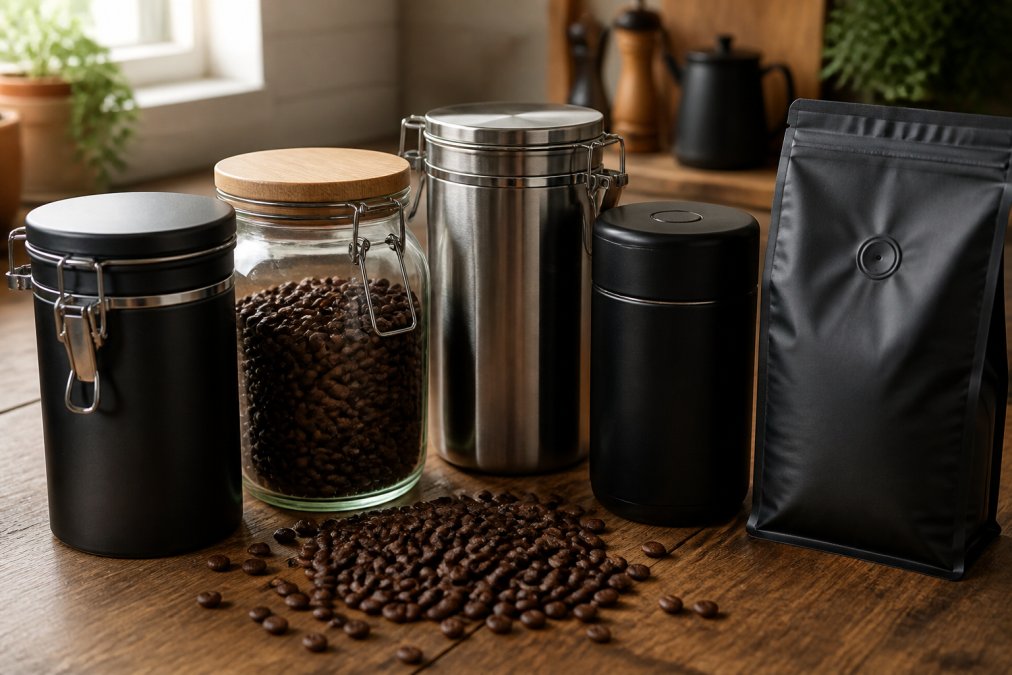
The best containers are airtight, opaque, and equipped to manage internal pressure. Material and design choices affect long-term performance significantly.
Container Material Science: What Actually Matters
Stainless steel is the most practical choice. It blocks light completely, resists odors and temperature fluctuations better than glass, and is durable. Double-walled stainless steel adds mild thermal insulation.
Ceramic performs similarly for light blocking and odor resistance but is heavier and fragile.
Glass is a common mistake. Clear glass provides zero light protection. Even tinted glass transmits enough light to accelerate oxidation. Glass must be stored in a cabinet to be effective.
Plastic is generally weakest for long-term storage. Many plastics are permeable to oxygen and absorb odors. Use food-grade, BPA-free plastic rated for airtight sealing.
The Air-Scape canister design, which uses a plunger mechanism to push air out before sealing, addresses oxygen exposure more effectively than standard screw-top lids.
Original Packaging vs. Airtight Canisters
Specialty roasters ship beans in bags engineered with one-way valves and nitrogen flushing to preserve freshness. For beans used within two weeks of opening, keeping them in the original bag, folded tightly and clipped, is reasonable. For longer storage or bulk quantities, transferring to a dedicated airtight canister reduces oxygen exposure more consistently.
How to Store Coffee Beans Step by Step
-
Check the roast date immediately. Calculate your two-to-four week freshness window.
-
Keep the original bag sealed until ready to open. Nitrogen flushing and one-way valves are working before you open them.
-
Portion your beans if the bag is large. Divide into weekly-use portions to limit air exposure.
-
Choose an opaque, airtight container. Stainless steel or ceramic with a tight-sealing lid is standard. Minimize headspace.
-
Store in a cool, dark location away from heat sources. A pantry shelf or cabinet away from the oven, dishwasher, or direct sunlight is ideal.
-
Do not store on the counter in a clear glass jar. Light exposure accelerates oxidation.
-
Grind only what you need immediately before brewing. This is the single most impactful step.
-
Reseal the container firmly after each use.
Can You Freeze Coffee Beans Without Ruining Them
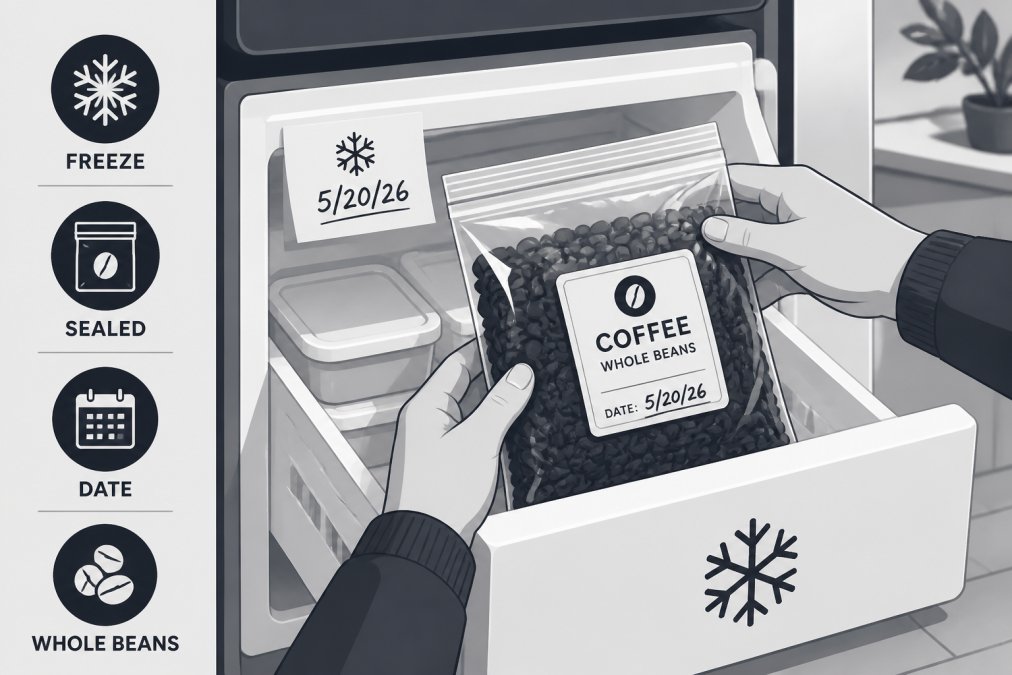
Yes, you can freeze coffee beans without ruining them. The critical variable is method. The biggest risk is not temperature but condensation. When cold beans are removed into a warm kitchen, moisture condenses on the surface, triggering premature extraction and off-flavors. Repeated freeze-thaw cycles compound this damage.
The Right Way to Freeze and Thaw: Post-Freeze Protocols
Vacuum sealing is most effective for long-term bulk storage. Vacuum-sealed bags remove oxygen before freezing, preventing freezer burn and limiting oxidation. A zip-lock bag is a distant second: squeeze out as much air as possible before sealing.
The correct post-freeze protocol:
- Remove the sealed bag from the freezer.
- Do not open immediately.
- Allow the sealed container to reach room temperature completely before opening (30 to 60 minutes).
- Once at room temperature, open and grind what you need.
- Do not return the opened portion to the freezer.
Each freeze-thaw cycle introduces new condensation risk and accelerates flavor loss. Portion beans into single-week quantities before freezing so each portion is only thawed once.
Altitude, Humidity, and Other Storage Factors Most People Ignore
Humidity matters most in coastal and southern climates. High ambient humidity accelerates moisture absorption through small container gaps. In Florida, Louisiana, or coastal California, canisters with silicone gasket seals and locking mechanisms provide better moisture resistance. Add a small food-safe silica desiccant packet inside the container to absorb residual moisture.
Altitude affects storage subtly. At higher elevations, lower atmospheric pressure means gases escape more rapidly from beans. Beans stored in Denver or Albuquerque may degas faster than at sea level, slightly compressing the optimal brewing window. This is minor compared to temperature and humidity.
Temperature fluctuations are more damaging than consistently warm temperatures. A pantry cycling between cool nights and warm afternoons creates expansion and contraction stress, accelerating off-gassing. A consistently cool location outperforms one with wide temperature swings.
As documented in USDA guidance on food storage and moisture control, controlling moisture and temperature stability are foundational principles for preserving food quality, and coffee is no exception.
Signs Your Coffee Beans Have Gone Stale
Stale beans won't make you sick but produce a flat, hollow cup that wastes good technique and water.
Reliable indicators:
- Loss of aroma. Fresh beans smell intensely when you open the container. Stale beans smell faint, papery, or vaguely rancid.
- Flat or sour flavor without acidity. Staleness produces dull, cardboard-like taste, different from intentional brightness in a light roast.
- Oily or waxy surface without freshness. Dark roasts naturally develop surface oils, but if beans look wet and smell rancid rather than rich, oil degradation has progressed too far.
- No bloom during brewing. Fresh ground coffee blooms when hot water is poured over it. No bloom means no residual CO₂, indicating beans are past their freshness window.
- Beans crumble or feel brittle. Fresh beans have structural integrity. Stale beans feel lighter and more fragile.
According to Penn State Extension resources on food chemistry and flavor degradation, volatile organic compounds responsible for aroma and flavor are among the most susceptible to environmental degradation, explaining why coffee flavor declines so rapidly under poor storage conditions.
The bloom test is quickest and most reliable. Grind a small amount and pour 200°F water over it. No visible bubbling within 30 seconds means beans are well past peak freshness.
Storing coffee beans correctly rewards attention to detail. The four enemies, the right container, the freeze protocol, and humidity variables all interact. Get them right and beans opened on day 14 taste nearly as good as day 5.
Timeless Voices Coffee roasts every order to order from carefully sourced farms worldwide, so your beans arrive with maximum carbon dioxide and a full freshness window ahead. That only holds if storage from your end matches the care taken on ours. A quality airtight canister, a cool pantry, and a grinder used immediately before brewing will protect every note we built into the roast. Visit Timeless Voices Coffee to explore single-origin options, blends, and sample packs, and get started with beans that are worth storing properly.
Frequently Asked Questions
Is it better to keep coffee beans in the original bag or transfer them to a jar?
The original bag is fine for short-term storage if it has a one-way valve and a resealable closure. For anything longer than a week or two, an opaque airtight canister does a better job because it blocks light and creates a tighter seal against oxygen exposure. Clear glass jars look attractive on a counter but accelerate staling because light degrades the volatile compounds responsible for aroma and flavor profile. Opaque stainless steel or ceramic canisters are the practical upgrade.
How long do coffee beans stay fresh in a sealed bag?
Whole beans in a properly sealed bag with a one-way valve stay at peak flavor for roughly two to four weeks after the roast date. After that, oxidation and oil degradation gradually flatten the aroma. Pre-ground coffee has a much shorter freshness window, often just one to two weeks, because grinding exposes far more surface area to oxygen. Checking the roast date rather than a best-by date gives you the most accurate read on freshness when you store coffee beans at home.
Should you store coffee beans in the freezer or pantry?
For beans you plan to brew within two to four weeks, a cool, dark pantry in an airtight container beats the freezer. Freezing makes sense only for bulk quantities you won't touch for a month or more. The main risk is condensation: moisture from temperature fluctuations causes freezer burn and accelerates staling. Portion beans into small airtight bags before freezing, and never refreeze a batch once thawed. Let frozen beans reach room temperature completely before opening the bag to prevent condensation from forming on the beans.
Does light and heat really affect coffee bean freshness?
Both are significant. Heat speeds up the chemical reactions that break down volatile compounds and degrade oils, which is why storing beans near a stove, oven, or sunny windowsill shortens their freshness window noticeably. Light, especially UV light, triggers oxidation even through some clear containers. The combination of heat and light exposure is one of the fastest ways to turn a quality roast stale. An opaque container kept away from any heat source is the single most impactful change most people can make when they store coffee beans at home.
This article was written using GrandRanker