

How to Brew Better Coffee at Home: A Complete Guide
Table of Contents
- Why Fresh Beans and Roast Date Matter
- Coffee to Water Ratio Guide: Getting the Proportions Right
- Coffee Grind Size Chart and Consistency Standards
- Best Water Temperature for Coffee and Extraction
- Brewing Methods That Deliver Better Coffee
- Storage, Freshness, and Equipment Essentials
- Sensory Training: Tasting Notes and Flavor Development
- Frequently Asked Questions
Last Updated: September 3, 2026
Why Fresh Beans and Roast Date Matter
The difference between stale coffee and fresh-roasted beans is immediate. When beans sit on a shelf for weeks or months, they lose the volatile compounds that create aroma, complexity, and flavor depth. A roast date tells you exactly how old your beans are, this single piece of information matters more than most other variables in your setup.
Fresh beans, ideally roasted within the past two weeks, contain oils and gases still developing. These compounds interact with hot water during brewing to create the nuanced flavors you're paying for. Beans older than four weeks begin a steady decline in flavor quality. After eight weeks, most of what made them special has faded.
Many home brewers buy premium beans from a grocery store shelf without checking the roast date, then wonder why their expensive coffee tastes flat. The beans were already past their prime before they arrived home.
At Timeless Voices Coffee, we roast beans to order specifically to solve this problem. Rather than sitting in warehouses or on retail shelves, your beans ship fresh within days of roasting. This ensures maximum flavor and aroma in every cup, which is the foundation for everything else you do with better coffee brewing technique.
The roast date becomes your baseline. Once you know your beans are fresh, all the other techniques in this guide actually matter. Without fresh beans, even perfect water temperature and precise ratios can't rescue mediocre coffee.
Coffee to Water Ratio Guide: Getting the Proportions Right
The coffee-to-water ratio is the most controllable variable in your brewing process. A consistent ratio means consistent results. Most coffee professionals use weight-based measurement rather than volume, because beans vary in density depending on roast level and bean type.
The standard starting point is 1:16 ratio by weight, meaning 1 gram of coffee to 16 grams of water. This produces a balanced cup for most brewing methods. If you prefer stronger coffee, move toward 1:15. For lighter, more delicate cups, try 1:17 or 1:18.
Here's the practical application: if you're brewing 30 grams of coffee, you'd use 480 grams of water at the 1:16 ratio. A simple kitchen scale transforms this from guesswork into repeatability.
Single-origin beans often shine at slightly higher ratios (1:17 or 1:18), which highlights their unique characteristics. Blends tend to perform well at the standard 1:16. Experiment within your preferred range and note what works.
| Brewing Method | Ratio | Grams Coffee | Grams Water | Result |
|---|---|---|---|---|
| Pour-over | 1:16 | 25g | 400g | Balanced, clean |
| French press | 1:15 | 30g | 450g | Full-bodied, rich |
| Cold brew | 1:4 | 100g | 400g | Smooth, low acidity |
| Immersion | 1:16 | 20g | 320g | Bright, nuanced |
Once you lock in your ratio, you've eliminated one major variable. This makes it easier to identify what else is affecting your results.
Coffee Grind Size Chart and Consistency Standards
Grind size determines how quickly water extracts flavor compounds from the grounds. Finer grinds expose more surface area and extract faster. Coarser grinds extract more slowly. The wrong grind size produces either under-extracted coffee (sour, thin) or over-extracted coffee (bitter, astringent).
A burr grinder is essential for consistency. Blade grinders produce wildly inconsistent particle sizes, mixing fine powder with larger chunks. This creates uneven extraction. A burr grinder produces uniform particles, which means uniform extraction.
Grind size varies significantly by brewing method. Pour-over typically uses a medium-fine grind, similar to sand. French press uses a coarse grind, with particles the size of breadcrumbs. Espresso requires a very fine, almost powdery consistency. Cold brew uses a coarse grind similar to French press because the long steeping time needs coarser particles to avoid over-extraction.

| Brewing Method | Grind Size | Particle Size | Appearance |
|---|---|---|---|
| Pour-over | Medium-fine | Sand texture | Slightly damp flour |
| French press | Coarse | Breadcrumb-sized | Chunky, loose |
| Cold brew | Coarse | Breadcrumb-sized | Same as French press |
| Espresso | Very fine | Powder-like | Fine talc powder |
| Immersion | Medium | Between sand and crumbs | Wet beach sand |
Consistency matters as much as the size itself. A burr grinder set to the same number should produce nearly identical grind sizes each time. This repeatability allows you to adjust other variables and actually see the effect.
Many home brewers use pre-ground coffee, which loses flavor rapidly because grinding increases surface area and oxidation begins immediately. Whole beans stay fresh much longer. If you're serious about brewing better coffee, grinding immediately before brewing is non-negotiable (peer-reviewed research).
Best Water Temperature for Coffee and Extraction
Water temperature controls the speed and completeness of extraction. Hotter water extracts faster and pulls more compounds from the grounds. Cooler water extracts more slowly. The ideal range for most brewing methods is 195-205°F, which is just below boiling (peer-reviewed research).
Boiling water (212°F) extracts too quickly and can scald the grounds, pulling excessive bitter compounds. Water below 195°F extracts too slowly, leaving sour, under-extracted flavors. The sweet spot in the 195-205°F range balances extraction speed with flavor balance.
Temperature consistency matters as much as the target temperature itself. Water that starts at 205°F but drops to 180°F during brewing creates uneven extraction. This is why preheating your brewing vessel is important.
Water quality is equally critical. Highly chlorinated tap water can impart off-flavors. Distilled water lacks minerals and produces thin, flat coffee. Filtered water with moderate mineral content (total dissolved solids around 150 ppm) produces the best results (peer-reviewed research).
Brewing Methods That Deliver Better Coffee
Different brewing methods produce distinctly different flavor profiles from the same beans. Understanding the differences helps you match your method to your beans and your preferences.
Pour-Over Brewing
Pour-over is the most controllable brewing method for home use. You control water temperature, pouring speed, pour pattern, and total brew time. This control translates directly to consistency and the ability to adjust results based on how your coffee tastes.
The pour-over process involves slowly pouring hot water over grounds in a filter, allowing gravity to pull water through. Paper filters remove oils and fine particles, producing a clean, bright cup. The brew time typically ranges from 2.5 to 4 minutes depending on grind size and pouring technique.
Bloom is a critical step that many home brewers skip. Bloom involves pouring just enough hot water to saturate the grounds (roughly twice the weight of the coffee), then waiting 30-45 seconds. During bloom, carbon dioxide escapes from the grounds, allowing better water contact. After bloom, continue pouring in a steady circular pattern until you reach your target water weight.
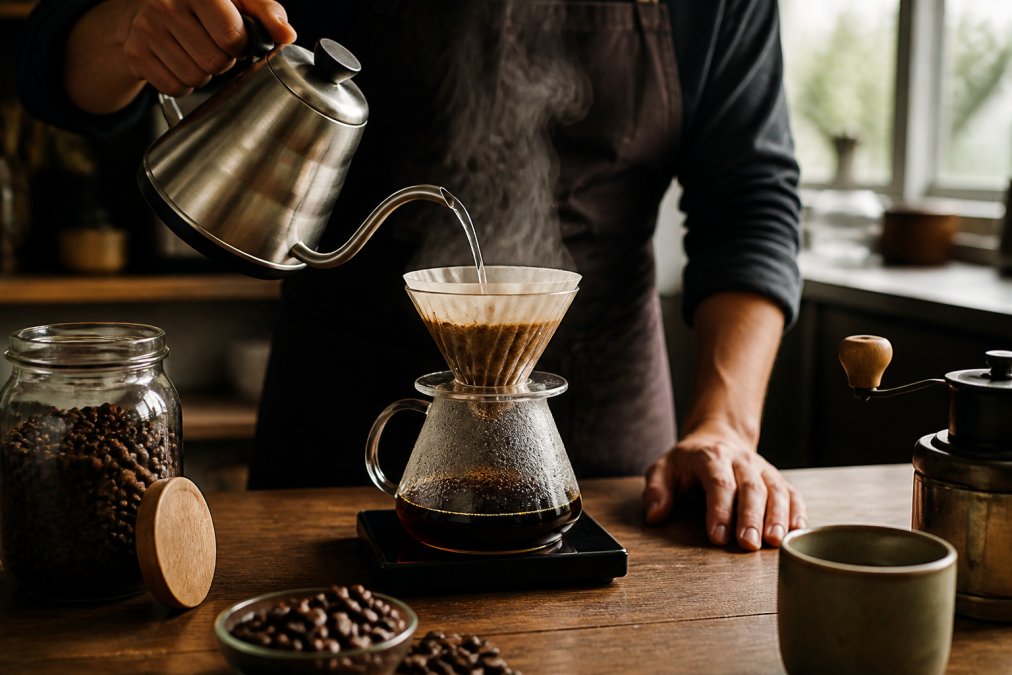
Pour-over is ideal for single-origin beans where you want to highlight specific flavor characteristics. The clean cup produced by paper filters allows subtle tasting notes to shine. If you're brewing fresh beans from Timeless Voices Coffee, pour-over gives you the clearest view of what those beans actually taste like.
Immersion Brewing and French Press
Immersion brewing submerges grounds in hot water for an extended period, typically 4-12 minutes depending on the method. French press is the most common immersion method for home use. The grounds stay in contact with water throughout the brew, extracting more oils and body than pour-over methods.
French press produces a fuller-bodied cup because the metal mesh filter allows oils to pass through. These oils carry flavor compounds and create texture. The trade-off is a slightly heavier mouthfeel and more sediment at the bottom of your cup.
The immersion process is straightforward: add coarse grounds to the vessel, pour hot water, stir gently, cover, and wait. After the target time, press the plunger down slowly to separate grounds from liquid. Longer brew times extract more, producing stronger, sometimes more bitter flavors. Shorter brew times extract less, producing lighter cups.
Immersion brewing is forgiving compared to pour-over. You don't need precise pouring technique or a gooseneck kettle. The method works well with medium and dark roasts that have bold, straightforward flavors.
Cold Brew for Convenience and Smoothness
Cold brew steeps coarse grounds in room-temperature or cold water for 12-24 hours. The long steeping time and cool temperature extract slowly, pulling fewer bitter compounds. The result is smooth, naturally sweet coffee with lower perceived acidity.
Cold brew concentrate is brewed at a higher coffee-to-water ratio (roughly 1:4 or 1:5), then diluted with water or milk before drinking. A single batch produces concentrate that lasts 2-3 weeks in the refrigerator, making it convenient for busy mornings.
The slow extraction at cool temperatures produces a distinctly different flavor profile than hot brewing. Delicate, fruity notes often come through more clearly in cold brew. This makes cold brew excellent for highlighting the characteristics of fresh, quality beans.
Timeless Voices Coffee offers a Cold Brew blend specifically formulated for this method, with a dark French roast and very coarse grind. The blend's bold characteristics shine in cold brew, producing smooth, rich concentrate ready to dilute and enjoy. You can find this blend at timelessvoicescoffee.com.
Storage, Freshness, and Equipment Essentials
How you store your beans after they arrive determines how long they stay fresh. Whole beans in an airtight container away from light, heat, and moisture stay fresh for 3-4 weeks. Once you grind beans, use them within 2-3 days for best flavor.
Light, heat, and oxygen are the enemies of coffee freshness. UV light degrades the oils that carry flavor. Heat accelerates oxidation. Oxygen causes staling. The ideal storage is an airtight container in a cool, dark place. Avoid clear containers and avoid the refrigerator or freezer, which introduces moisture.
Vacuum-sealed bags with one-way valves are excellent for storage. These bags allow carbon dioxide to escape while preventing oxygen from entering. If your beans arrive in bags with one-way valves, you can store them directly in those bags after opening.
Equipment doesn't need to be expensive, but certain pieces are worth the investment. A burr grinder is essential. A kitchen scale accurate to 0.1 grams is critical for consistency. A gooseneck kettle gives you better pouring control for pour-over methods. A timer helps you track brew time accurately.
The relationship between equipment and results is often overstated. A $15 pour-over cone with paper filters produces better coffee than a $300 automatic machine if you use proper technique and fresh beans. Invest in the fundamentals first: fresh beans, a burr grinder, a scale, and a thermometer.
Sensory Training: Tasting Notes and Flavor Development
Learning to taste coffee intentionally transforms how you experience it. Most people drink coffee without paying attention to flavor characteristics. Sensory training teaches you to notice acidity, body, mouthfeel, and specific tasting notes like chocolate, berries, or floral qualities.
Acidity in coffee is not sourness. It's brightness and liveliness on your palate. High-acidity coffees feel crisp and energetic. Low-acidity coffees feel smooth and mellow. Single-origin beans from high-altitude regions typically have higher acidity. Darker roasts have lower acidity.
Body refers to the weight and texture of the coffee on your tongue. Light-bodied coffee feels thin and clean. Full-bodied coffee feels heavy and rich. Brewing method affects body: pour-over produces lighter body, French press produces heavier body. Roast level also matters: darker roasts typically have fuller body.
Tasting notes describe specific flavors you might detect. A coffee might have notes of dark chocolate, cherry, and caramel. These notes come from the bean's origin, altitude, processing method, and roast level. Learning to identify them requires practice and intentional tasting.
A simple tasting exercise: brew two cups of the same coffee using different methods (pour-over and French press, for example). Compare them side by side. Notice the differences in body, texture, and how flavors come across. This direct comparison teaches you more than reading descriptions.
Brewing better coffee at home comes down to controlling the variables you can control: bean freshness, grind consistency, water quality, temperature, and technique. Start with fresh-roasted beans and work through each variable systematically.
Timeless Voices Coffee delivers fresh-roasted beans directly to your door, eliminating the staleness problem that undermines most home brewing. With fresh beans as your foundation, the techniques and equipment adjustments in this guide create noticeable improvements in every cup.
Frequently Asked Questions
Q: What is the most effective way to brew better coffee at home?
A: The most effective approach combines three fundamentals: using fresh-roasted beans (within 2-4 weeks of roast date), maintaining a consistent coffee-to-water ratio of 1:16 to 1:17 by weight, and controlling water temperature between 195-205°F. Choose a brewing method that suits your routine, pour-over for precision, immersion brewing for simplicity, or cold brew for smooth, low-acidity results. A burr grinder ensures uniform grind size, which directly impacts extraction consistency. Timeless Voices Coffee's fresh-roasted options arrive within days of roasting, eliminating the staleness problem that undermines most grocery store coffee.
Q: How does water temperature affect coffee extraction?
A: Water temperature controls how quickly coffee compounds dissolve during brewing. Water below 195°F extracts too slowly, resulting in sour, under-extracted coffee with thin body and weak flavor. Water above 205°F extracts too quickly, pulling out excessive bitterness and tannins, creating harsh, over-extracted cups. The ideal range of 195-205°F allows balanced extraction of acids, sugars, and aromatic compounds that create complexity and mouthfeel. Consistency matters: even a 5-degree variance shifts the flavor profile noticeably. Using filtered water also prevents mineral buildup on equipment and ensures total dissolved solids don't interfere with extraction.
Q: Why is a burr grinder essential for better coffee?
A: A burr grinder produces uniform particle size, which ensures even extraction across all grounds. Blade grinders create inconsistent chunks and powder, causing some grounds to over-extract (bitter) while others under-extract (sour), resulting in muddy, unbalanced cups. Burr grinders, whether flat or conical, maintain consistent grind size for your chosen brewing method. For pour-over, you need medium-fine particles; for French press, coarse particles. This control is impossible with blade grinders and is the single biggest upgrade most home brewers make. Pair a quality burr grinder with fresh beans from Timeless Voices Coffee to unlock the full flavor potential that roasters intended.
Q: How do I know when my coffee is under-extracted or over-extracted?
A: Under-extracted coffee tastes sour, thin, and weak, with sharp acidity that dominates the cup. The body feels watery, and you'll notice missing sweetness and complexity. This happens when water is too cool, contact time is too short, or grind size is too coarse. Over-extracted coffee tastes bitter, harsh, and astringent, with a dry mouthfeel that coats your mouth unpleasantly. The body may feel heavy but flat, lacking brightness. This occurs with water that's too hot, too long contact time, or grind that's too fine. Proper extraction (hitting the sweet spot) produces balanced acidity, sweetness, body, and aromatic tasting notes. Most home brewers under-extract; adjust by using hotter water, finer grind, or longer steeping time.
Q: What is the 1:16 coffee to water ratio, and how do I measure it?
A: The 1:16 ratio means 1 gram of coffee to 16 grams of water by weight, a standard starting point that works across most brewing methods. For example, 25 grams of coffee with 400 grams of water produces a balanced cup with good body and clarity. To measure accurately, use a kitchen scale (essential for consistency). Weigh your whole beans before grinding, then weigh your water. This removes guesswork and lets you adjust: go 1:15 for stronger, more concentrated coffee, or 1:17 for lighter, more delicate cups. Many brewers skip the scale and eyeball it, but scales cost $15-30 and are the fastest way to eliminate the biggest source of inconsistency in home brewing.
Q: Should I buy whole beans or pre-ground coffee?
A: Whole beans are always superior for flavor. Coffee begins losing aromatic compounds and freshness within 15 minutes of grinding due to oxidation. Pre-ground coffee from grocery stores may be weeks or months old, and grinding accelerates staling. Whole beans stay fresher longer when stored properly in an airtight container away from light and heat. Grind just before brewing, this takes 2-3 minutes with a burr grinder. If convenience is your priority, Timeless Voices Coffee's single-serve capsules deliver sealed, oxygen-free freshness with no grinding required, maintaining flavor without the staling problem of pre-ground bags. You can find our 12-pack single-serve coffee capsules at [https://timelessvoicescoffee.com/products/12-pack-single-serve-coffee-capsules] or our 60-pack at [https://timelessvoicescoffee.com/products/60-pack-single-serve-coffee-capsules].
Q: What is the difference between single-origin and blend coffees?
A: Single-origin coffee comes from one specific farm or region, showcasing that terroir's unique tasting notes, floral, fruity, chocolatey, or earthy characteristics. Blends mix beans from multiple origins to create balanced, consistent flavor profiles. Single-origins highlight complexity and regional character; blends prioritize balance and reliability. Single-origins often cost more and vary seasonally. Blends offer consistency and are forgiving for beginners. For exploring flavor, start with single-origins. For daily drinking, blends provide dependable smoothness. Timeless Voices Coffee offers both, letting you choose based on whether you're chasing discovery or comfort.
Q: How should I store coffee to keep it fresh longer?
A: Store whole beans in an airtight, opaque container away from direct sunlight, heat, and moisture. Avoid the freezer, thawing creates condensation that degrades flavor. Keep beans at room temperature in a dark cupboard or pantry. Unopened bags in cool, dark conditions stay fresh for 3-4 weeks; opened bags decline noticeably after 2 weeks. Once ground, use within 24 hours for best results. Vacuum-sealed bags extend shelf life, but once opened, transfer to an airtight container. Timeless Voices Coffee roasts to order and ships within days, so your beans arrive at peak freshness. Proper storage then preserves that quality through the brewing window.
This article was written using GrandRanker